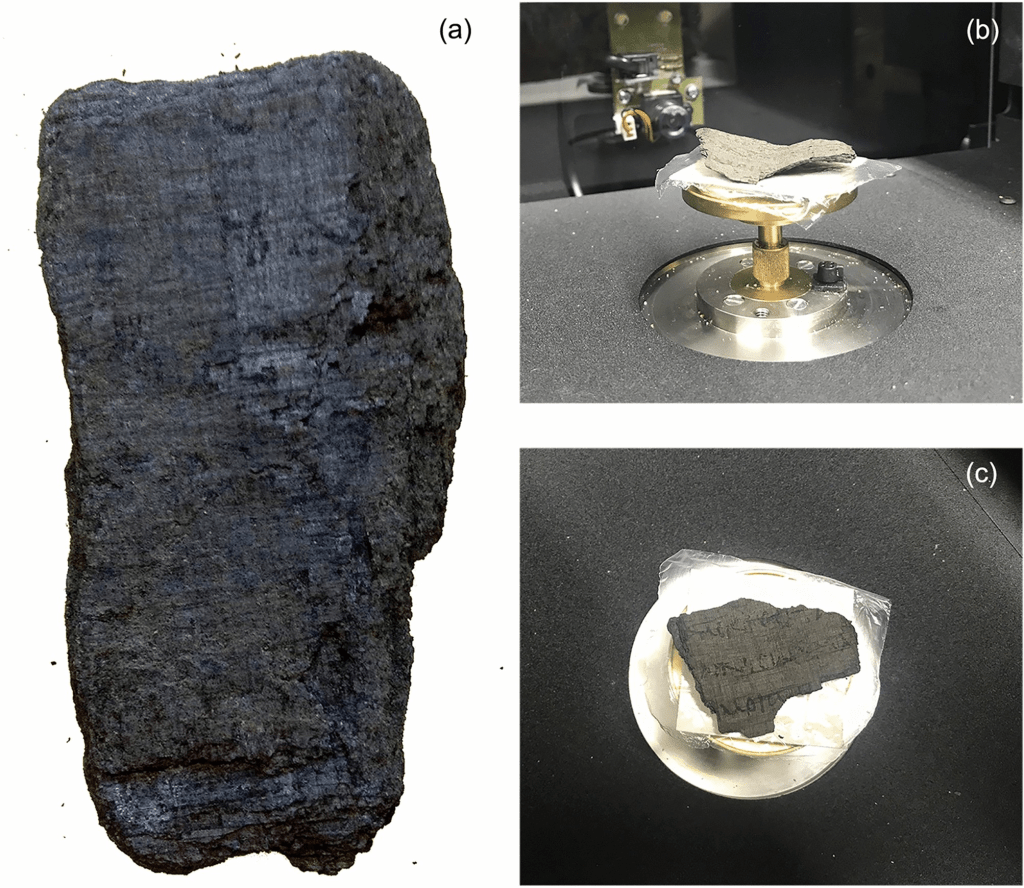
One of the most remarkable applications of digital history tools currently in the news has been the work done in decoding the charcoal papyri recovered from the library of Herculaneum, the ancient Roman city destroyed in the 79 AD volcanic eruption of Mount Vesuvius alongside Pompeii. The Herculaneum scrolls, numbering nearly two thousand, are one of the largest surviving collections of papyri from antiquity, believed to contain a diverse array of works of literature and philosophy. Due to their extreme fragility, unrolling and reading the scrolls has been extremely challenging for archaeologists- until the recent application of digital tools revolutionized the method used to study them.
In recent years, there’s been a string of attempts to “virtually unroll” the Herculaneum scrolls by using x-ray scans to render a detailed three-dimensional model of the artifacts and then use artificial intelligence and other tools to distinguish ink from the papyrus. In 2023, a group of technology investors announced grand prize of up to $700,000 to decode passages from the Herculaneum scrolls, and since then there have been a number of breakthroughs towards full decipherment. In February 2024, the first passages of a previously unknown work by the Epicurean philosopher Philodemus were fully deciphered.
The new work that’s been done to study the Herculaneum scrolls reveals the incredible potential of digital tools to push the boundaries of our historical knowledge. What was for years considered near-impossible has now been effectively accomplished- revelations of ancient philosophy have been deciphered from pieces of volcanic charcoal. The techniques used to read the Herculaneum scrolls are not necessarily widely usable on other artifacts- the scrolls are an extremely unique case of historical preservation. However, the practice of 3D modeling used to study them may have broader applicability for the study of fragile artifacts, allowing them to be analyzed in close detail while ensuring responsible preservation. Beyond that, I find the decipherment of the Herculaneum scrolls an incredible reminder of how many transformative historical discoveries may be yet to be made.
Read more from the Smithsonian magazine’s article on the subject: https://www.smithsonianmag.com/smart-news/using-ai-researchers-peer-inside-a-2000-year-old-scroll-charred-by-mount-vesuvius-eruption-180986011/
 History Against the Grain
Leave a comment