Hello and welcome readers! This is a blog where I’ll be exploring a range of history topics and the presentation of history in digital media to complement an academic project. I’ll be posting a new entry roughly once a week.
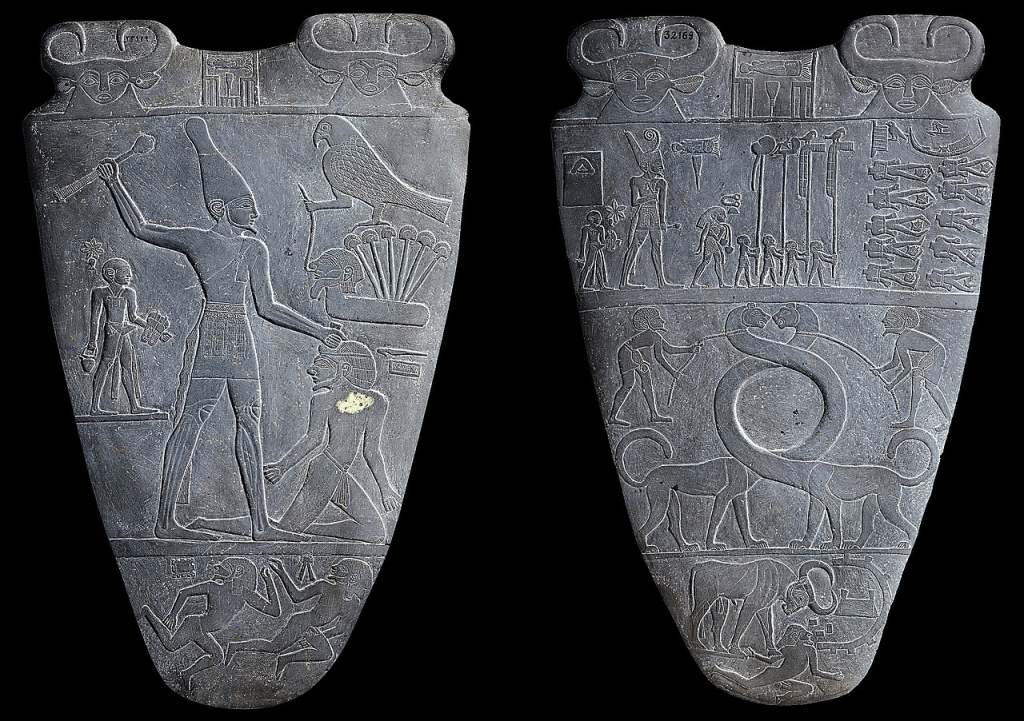
One artifact that I found to be an interesting piece to begin a history blog with that provides unique historical insight but reminds us of some of the limitations of historical work, would be the Narmer Palette. The Narmer Palette is a siltstone engraving originating from the city of Nekhen that dates to some time around ~3000 BC, depicting the triumph of the Pharaoh Narmer who is generally agreed to be the first ruler of a unified Egypt from the mouths of the Nile to the first cataract. The Narmer Palette was recovered by archaeologists in 1898 and is today preserved in the Egyptian Museum of Cairo.
Large siltstone palettes were common in Early Dynastic Egypt and were conventionally used to grind and mix cosmetic ingredients. However, some palettes such as this one, which is ornately decorated on both sides, were purely artistic. The Narmer Palette has been described by some scholars as one of the oldest surviving representations of a historic event, with the vanquished figure to the right representing the Lower Egyptian ruler who Narmer defeated in battle to establish a unified rule over Egypt. While this interpretation of the palette is not entirely agreed upon, it does reveal something substantial about how ancient societies began to preserve historical memory in written inscriptions and the view that this can present to modern observers.
Routinely, the earliest written references to socio-political events and the figures involved in them that historians and archeologists have observed describe warrior-kings , their conquests and edicts- from Egypt to its neighbors in Syria, Sumer and Elam similar ideological and artistic motifs to the Narmer Palette can be seen- notably but not limited to the “Master of Animals” iconography showing a king or deity in control of powerful beasts. The picture given by these earliest historical records can suggest that some patterns of emergent social stratification and the consolidation of states through warfare were essential by-products of the development of agricultural, urbanized and literate societies- potentially, but one of the most critical lessons of the Narmer Palette is that the first individuals to record history will be the first with the means and motive to do so. Narmer had only recently consolidated what might have been the largest single realm on Earth at his time. For early Egyptian rulers, inscribing their serekh (a unique hieroglyphic representation of the Pharaoh’s name) provided tangible evidence and reminders of their rule. King lists offered legitimacy that connected the Pharaoh to those who came before them. Artistic representations of victorious battles could intimidate potential rivals, and most significantly, absolute monarchs had a substantial demand for writing to manage the administration of a nascent state.
When we bring history into the digital realm, we’ll always face the challenge that the records which exist will always be vastly incomplete or biased, often in subtle ways that aren’t immediately obvious. Works like the Narmer Palette offer a window into an otherwise forgotten time, but it’s important to communicate just how narrow that window can be.
 History Against the Grain
Leave a comment